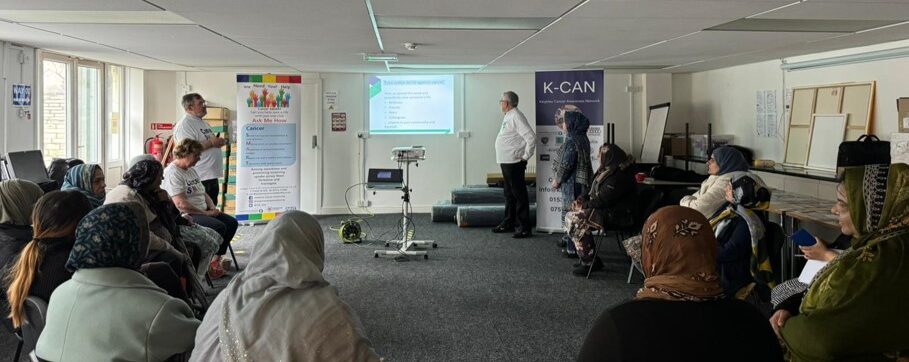
The Keighley Cancer Awareness Network (K-CAN) was one of the 63 projects funded via the Core20Plus5 programme in 2023 via Bradford District and Craven’s Healthy Communities team.
The decision to develop a project specifically to tackle cancer, predominantly within the south Asian community in Keighley was borne out of the use of evidence-based data provided by the Reducing Inequalities Alliance. The data highlighted that within the Keighley area, there was a lower-than-average uptake for breast, bowel and cervical cancer screenings, compared to other localities within the district, with particularly low uptakes among women from a south Asian background.
It was decided that this may be due to women not responding to communications about screening from their GP and subsequently not coming forward for their screening appointments. This could be attributed to variety of factors such as language barriers and needing extra support with navigating the healthcare system.
Furthermore, the mortality rates for cancer were considerably higher in west and central Keighley. This highlighted the importance in raising awareness of the signs and symptoms of cancer to help early diagnosis.
Working with a community and voluntary sector partner
The Community Partnership wanted to raise awareness of the signs and symptoms of cancer and increase the uptake of breast, bowel and cervical cancer screenings.
To do this, they chose to work with the voluntary and community sector due to their strong track record with engaging with communities in Keighley. Keighley Association for Women and Children’s Centre (KAWACC), a trusted partner who had already provided support to members of the south Asian community, were successful in their expression of interest to deliver the project.
Building a network of trusted and influential champions who could share positive health messages
KAWACC worked to set up the Keighley Cancer Awareness Network, a network of 12 different organisations, such as community groups, and GP partners which all operated across different geographic footprints of Keighley.
Together they worked to recruit a group of health champions, who worked within local VCS organisations and so were a familiar face within their community and who could work to share positive health messages. Some of the volunteers also spoke different languages, (Urdu, Bangla, Polish and Slovak) which enabled them to communicate with non-English speaking members of their community.
The volunteers received quarterly training (some from cancer organisations such as Cancer Research and Marie Curie) across a broad range of topics such as the signs and symptoms of cancers to the importance of healthy eating and exercise. This information and knowledge would then enable them to have useful conversations with family, friends and members of their community about recognising cancer and signpost people to trusted resources.
Working with GP Practices and supporting patients
The champions also worked with GP practices on local events as well as supporting and encouraging patients to come forward for their screening appointments. One GP Practice hosted a cervical screening drop-in session to help their patients understand more about the screening process. This was supported by the health champions in the area who helped to promote the session.
Some of the champions were also on hand to provide emotional support to those who had received a cancer diagnosis, helping them to work through and understand complex information as well as collecting people from their homes to attend their appointments where needed.
Conclusion
The Keighley Cancer Champions project has been running for 18 months now and within that time, the network has been able to support the community and spread positive health messages through delivering over 66 community events, with over 700 people attending. They have also supported over 500 families with health concerns.
Key impacts
- The development of a network of trusted and supportive health champions who are able to support their community with one service user positively reporting: “You were 100% there for me: phone calls, turning up and taking me to out of hours appointments”.
- Regular training sessions to help the health champions stay up to date with their knowledge.
- A more joined up approach for health and community partnerships across the Keighley area: GP partners and community organisations are supporting one another for their community engagement events, with the health champions encouraging people to attend.
- A greater understanding of the prevalence of cancer and where to signpost people to support and resources.
Evaluation and metrics
Breast and bowel cancer screening numbers across the whole of the Bradford district and Craven area retain their position as higher than the regional average. Hyper local data suggests that this apparent average uptake in screening numbers fails to illustrate the differences between more affluent and deprived areas. This is necessary to consider as overall district wide data sets may not show the nuance across small areas such as Keighley council ward and apparent differences in take up of screening programmes.
Cervical screening uptake continues to be the screening area of greatest concern in Keighley with an uptake of 64.8% in the last 12 months which is approximately 10% lower than the most affluent areas in Bradford district.
Key learning
The work of the Keighley cancer champions has taught us:
- The importance of using local voluntary organisations to be a conduit into communities with important health messaging breaking down barriers in language and culture.
- The potential reach of such projects may be previously underestimated with this project reaching a large number of residents in a short period of time.
- The value of upskilling local people can be underestimated and therefore training and development opportunities for peer models should be encouraged as in this project.
- By using population health data, we can focus attention on a specific cohort of residents with very specific messaging increasing the impact from small projects.
- Projects of this nature are very difficult to monitor the impact of, however case studies and numbers reached can be used alongside a theory of change to make assumptions on contributing to changing behaviours.
Learn how this project aligns with our Core20PLUS5 Theory of Change here.
View more inequalities stories below or on our Reducing Inequalities Alliance webpage. To write a blog about inequalities work you’re involved in, please email ria@bradford.nhs.uk
More inequalities blogs